

Progesterone: what it actually does in the brain
Understanding the relationship between progesterone and PMDD and perimenopause

If you have heard about progesterone, you may think of it as a hormone that is only important in implantation and pregnancy. And it is important in those circumstances, but it is also a very important hormone in your life outside of conception, especially when it comes to your brain function every month.
We talk about estrogen constantly (to be fair, estrogen is my favorite hormone), and I remember sitting with Sarah E. Hill, PhD interviewing her for my podcast talking about hormones and the brain and she told me progesterone was her favorite hormone. I laughed at our different takes, but this stuck with me. A researcher who studies hormones and the brain, and she loves progesterone, maybe I should give it more of a chance.
Perhaps my reasons for not loving progesterone are my own pregnancy losses? Was my body unable to make the progesterone I needed when I was trying to conceive? Maybe we need to think about progesterone not as a second tier reproductive hormone, but as one of the most powerful signals your brain receives.
Today I am reviewing the science of progesterone as a brain hormone and why it matters throughout your reproductive life. Maybe you are trying to conceive, maybe you are avoiding pregnancy, maybe you are in perimenopause wondering what is going on.
There is a big difference in progesterone and progestins, and we can look at what happens in our brains with premenstrual dysphoric disorder (PMDD) as a great starting point.
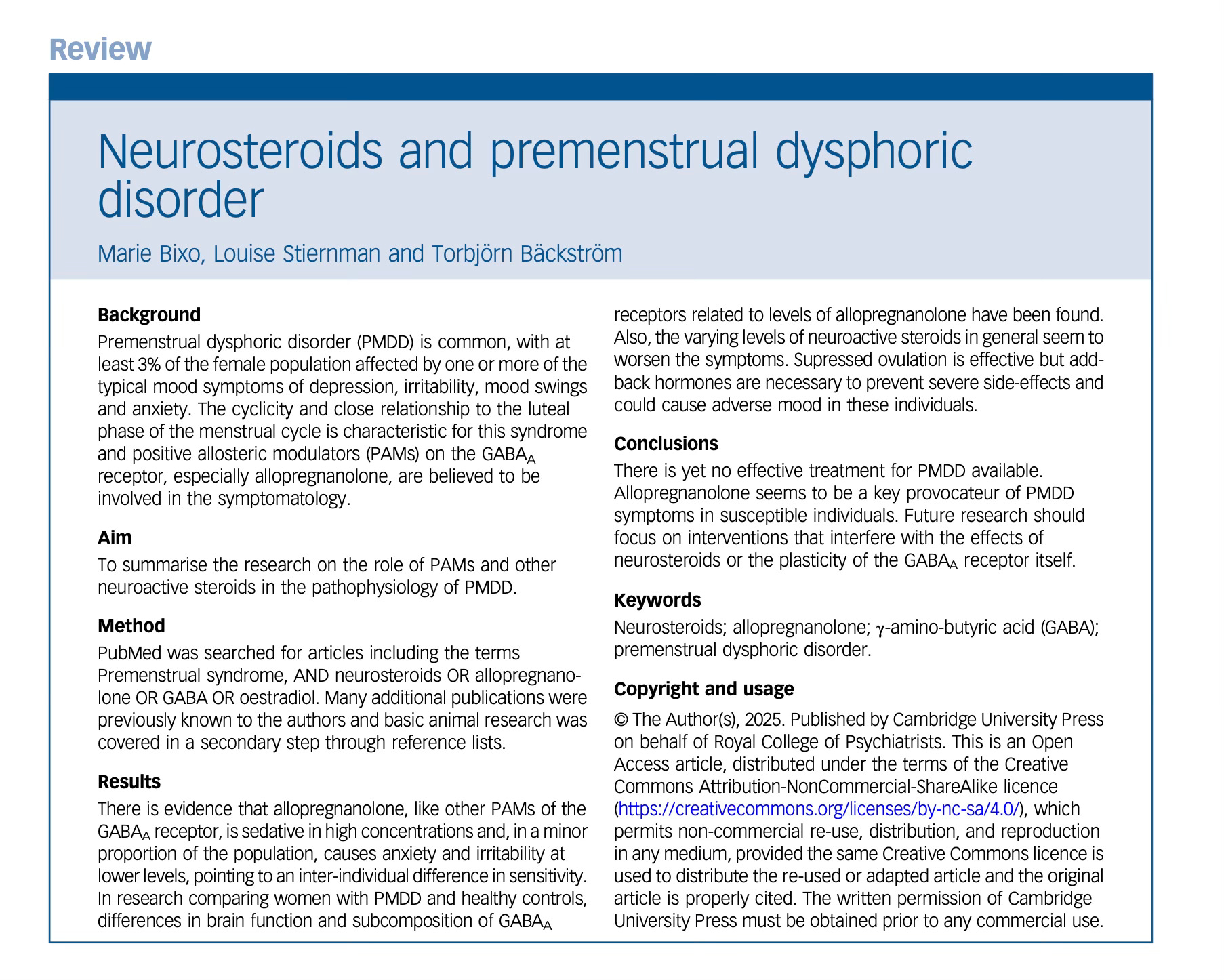
Study: Neurosteroids and Premenstrual Dysphoric Disorder
Journal: The British Journal of Psychiatry
Why this study caught my attention:
We typically think about hormones as being high or low, forgetting that your hormones are a dynamic communication system in your body. They talk to organs, they respond, and a single level is typically not diagnostic. And one concept that I talk about a lot with my fertility patients is that lab values do NOT tell the entire story. You have your own internal reference range, determined by your brain. Learning to lean into your body, and how it feels, and learn what normal is for you.
This review asks that exact question: does the same hormone at the same level impact each woman differently?
This is especially important to me because I see women get dismissed for progesterone related symptoms all the time. Maybe it is PMS, PMDD, short luteal phase, recurrent pregnancy loss, perimenopause or sleep issues. Across the board, these complaints are often not taken seriously, are attributed to anxiety or over reacting, and yet there is a real mechanism behind what is happening that we deserve to understand so we can advocate for our health the best
So today I am reviewing:
What progesterone actually does in your brain
The relationship between PMDD, mood disorders, and hormones
A breakdown of this study
Recommendations for PMDD
Recommendations for perimenopause
First, what progesterone actually does in your brain
Progesterone is not constantly available in your cycle. Most progesterone you make comes from the corpus luteum after ovulation. Remember that a follicle grows and egg, that follicle ruptures after ovulation, and then the same follicle reforms to become a corpus luteum—a progesterone producing cyst.
One big misconception is that progesterone is constantly produced, and it is not. Progesterone is made in pulses from the corpus luteum, stimulated directly from LH pulses from the brain. This means that after ovulation progesterone can range anywhere from 3-40 ng/mL. You can see that one difficulty with progesterone measurement is exactly that. How do you know if “enough” progesterone is released if it is made in pulses?
The second half of the menstrual cycle, the time after ovulation, is known as the luteal phase. Normal progesterone production and luteal phase length are important for implantation and conception. But beyond pregnancy you may not know that the luteal phase is giving you crucial details about your hormone health. In fact, a short luteal phase (<11 days in length) is the first sign of an ovulation disorder. Too often we think about ovulatory issues being a yes or no—you either ovulate or you do not. But in reality, ovulation is a spectrum and it can move from working perfectly through a variety of stages of dysfunction: starting with a short luteal phase, then a long follicular phase, irregular cycles, and eventually amenorrhea (no periods).
Luteal phase deficiency (LPD) is a clinical, and not a lab diagnosis. Having a short luteal phase or bleeding in the luteal phase are hallmarks of a LPD, but no blood level will tell us that the luteal phase is “normal” since blood progesterone levels fluctuate throughout your luteal phase. A luteal progesterone level is only helpful in confirming that you did ovulate, with a value of > 3 ng/mL being confirmatory that ovulation did in fact occur.
Importantly, this story changes with pregnancy. When a pregnancy makes hCG (the pregnancy hormone), hCG and LH bind to the same receptor and now progesterone is being constantly stimulated to be released (and at an increasing signal as hCG rises as the pregnancy progresses). One mistake people often use is looking at “normal” progesterone levels in early pregnancy and assuming mid-luteal progesterone should be the same.
Just because something is difficult to measure doesn’t mean it isn’t important. In addition to normal ovulation, progesterone is important in mood, brain function, and sleep via allopregnanolone.
When progesterone is made after ovation, a portion is converted into a compound called allopregnanolone which is what you really need to understand. Allopregnanolone acts on a receptor in the brain called GABA-A, which is the same receptor targeted by anti anxiety medications and alcohol. I want you to think about GABA being your nervous system’s main calming signal. When allopregnanolone binds to GABA-A it enhances the calming effect. This is why progesterone in the luteal phase can feel steadying and result in a better night’s sleep.
So if you’ve ever heard me say that progesterone is a “calming” hormone—this is what I mean. But what this study asked is if allopregnanolone crosses the brain and “calms” it then shouldn’t more of it be better and less of it be worse? But actually, that’s not what most people experience.
Allopregnanolone follows a biphasic curve: where at high concentrations it is calming and sedative but at lower or fluctuating levels it may actually do the opposite triggering anxiety, irritability and even low mood. This means the same molecule on the same receptor has different effects depending not only on dose but also on your own brain. This means two women can have the identical progesterone levels and different experiences based on how their GABA-A receptors respond, and this is important for you to understand.
In perimenopause, progesterone levels tend to fluctuate immensely due to the abnormal communication between the brain and ovary seen with a lower ovarian reserve. This means ovulation become abnormal—maybe happening earlier (you might see shorter cycles), maybe happening later (long cycles), or maybe you have irregular cycles and no clue when you are ovulating. These progesterone fluctuations become more severe—resulting in noticeable symptoms.
